

Queen Anne Branch Highlights
The historic Carnegie-funded Queen Anne Branch is listed in The National Register of Historic Places. It has been named a landmark building by Seattle's Landmarks Preservation Board.
Seattle readers can often be found under tall cedar trees on the front lawn of the Queen Anne Branch. Stained-glass windows and a wood-lined central reading room provide a cozy indoor reading experience. The auditorium hosts community organizations, book clubs and hobbyist groups.
History
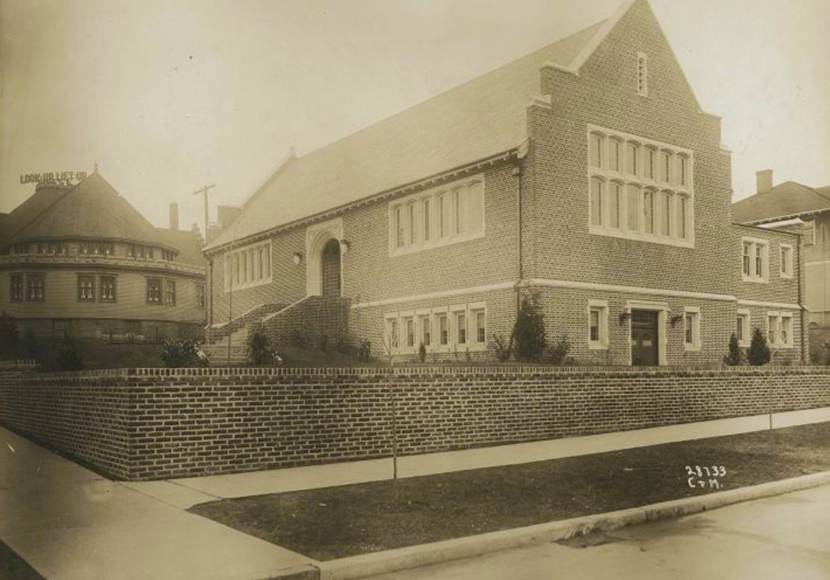
Serving the Queen Anne community since 1914
In 1911, industrialist Andrew Carnegie donated $70,000 to build two branch libraries in Seattle. One of them was in Queen Anne, and the two-level branch opened on New Year's Day in 1914.
The lower-level auditorium has long been a meeting place for community groups. In the early 20th century, the Earwig Club met at the Queen Anne Branch. The Seattle Chamber of Commerce charged the club with eradicating the bug. At the time, the pest was ravaging the Pacific Northwest’s cultivated plants.
In 1978, artist Richard Spaulding created a series of five stained-glass mural windows for the central reading room. A federal employment program and the City’s arts commission funded the art.
The Library Renaissance Fund Initiative of 1984 paid for repairs to exterior brickwork that began in 1987. New oak cabinets refurbished the library’s interior. Technicians upgraded the plumbing, heating, and electrical systems. Workers built an ADA accessible entrance on the west side of the building. The Queen Anne Branch reopened in 1989 with seismic protection.
A voter-approved 1998 "Libraries for All" bond measure funded renovations in 2007. Technicians improved ventilation and electrical connections. Workers restored the original design of the wings. In 2018, workers made repairs and upgrades to the building’s skylight, roof, and chimney.
Architecture
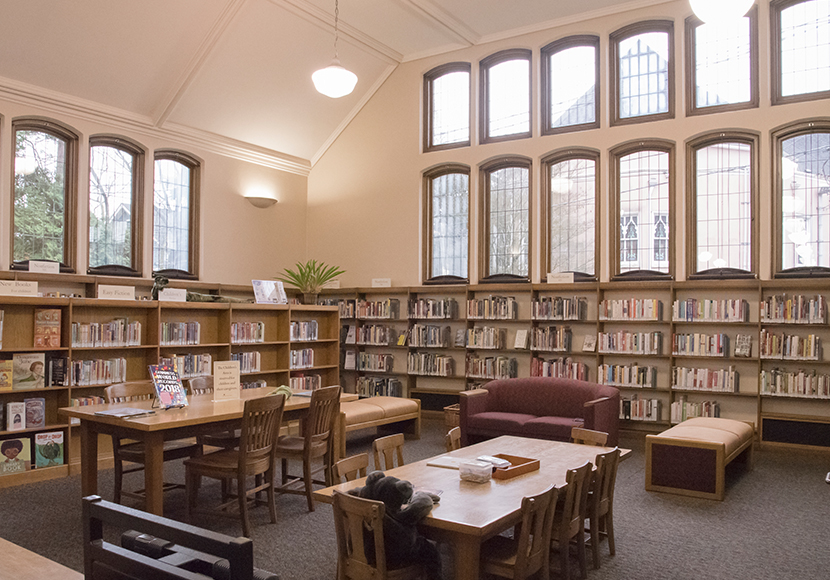
Tall ceilings with large leaded glass windows and hanging lamps give the building a spacious feel. Its general architectural style is Late Tudor Revival. Golden oak woodwork dampens sound throughout the library.
The building follows one of Carnegie's preferred designs for libraries. It has a main-floor reading area with a lower-level auditorium. The children’s area is in the west wing and the teen and adult areas are in the east wing.
A 2018 roof replacement removed the original slate tile roof from 1914. Workers used slate sourced from New York and Vermont to create a new roof. The new slate roof was matched to maintain the color and texture of the historic roof. The tiles were installed based on the original 1914 design.
In 2023, the Queen Anne Historical Society awarded “Outstanding Renovation” to The Seattle Public Library. The award recognizes the Library’s historical preservation work with the slate tile roof replacement for the Queen Anne Branch.
Architects: Hoshide Williams Architects, 2007; W. Marbury Somervell and Harlan Thomas, 1914.
Art
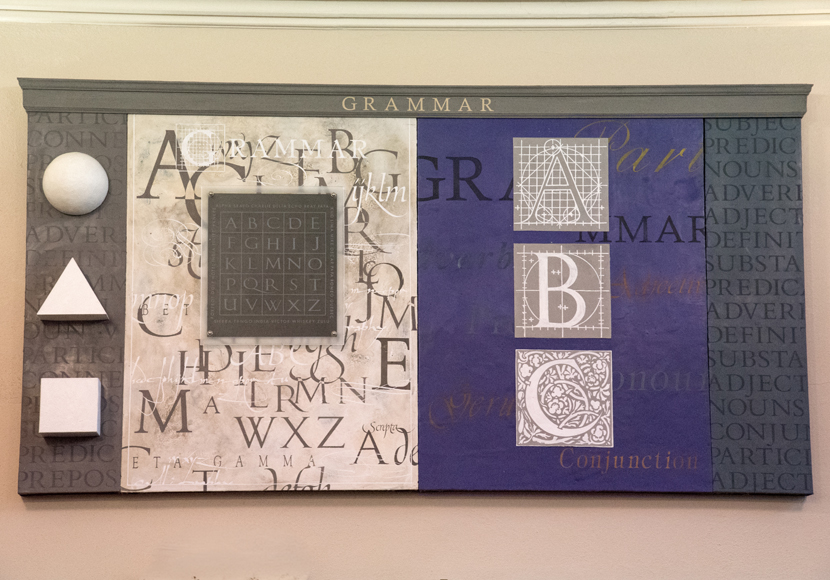
Seven Liberal Arts Suite: Grammar, 2005
Dennis Evans
“Grammar” is a large, two-paneled installation. The art is located on the northwest wall of the Central Room, and on the north wall of the Linda Larson and Gerry Johnson Family Reading Area. It celebrates the art of inventing and combining symbols. It is made of mixed media, oil, and wax paint on canvassed wood panels. Evans has art displayed nationwide that explores education, history, and lifelong learning. “Grammar” was funded by the 1998 Libraries for All bond measure.
“Grammar” is part of the Seven Liberal Arts Suite found at the Fremont, Green Lake, Queen Anne, University, and West Seattle branches.
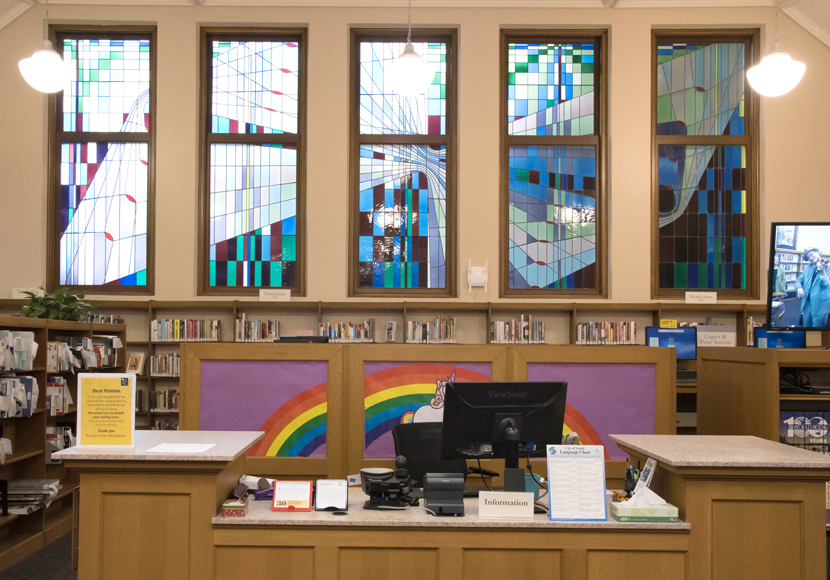
Quintet in D, 1978
Richard Spaulding
“Quintet in D” is a set of five large stained-glass windows in the branch’s central reading room. Spaulding, a PNW artist with worldwide exhibits, puts colors together the same way as music. The windows use color and parabolic forms to show Seattle’s magnetic field and radio frequency spectrum. "Quintet in D" was funded by the legacy of Eugene E. Atwood and the City of Seattle Arts Commission.
Named Spaces
Spaces named for donors include:
- Lois and Nelson Anderson & Anne Anderson Questad Children's Area
- Linda Larson and Gerry Johnson Family Reading Area
- Stuart H. Prestrud Meeting Room