

Magnolia Branch Highlights
The Magnolia Branch of The Seattle Public Library has award-winning architecture and landscaping. It is a neighborhood haven for leisure reading and study.
The Magnolia Branch provides services for children and families from the nearby Daybreak Star Indian Cultural Center. It has books in Native languages. The collections support urban Native and global Indigenous communities.
History
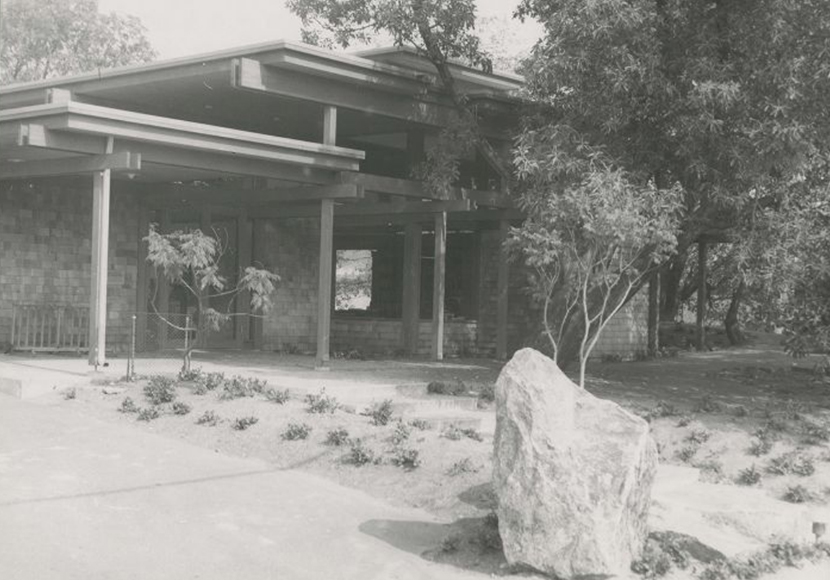
Serving the Magnolia community since 1943
In 1943, Magnolia residents raised money for a lending library. They rented a vacant tavern and called it the Magnolia Bluff Station. Library stations had smaller collections of books and were open fewer hours than Library branches. They served the city during times of recession or immigration booms.
The Seattle Public Library provided books and part-time librarian help. The lending library moved several times. In the late 1940s, it began providing full library services. Residents asked for a permanent location. In 1952, the building was flooded three times: once by vandals placing a hose in the mail slot, another from the pipes freezing, and lastly by heavy rains.
In 1956, Seattle voters passed a $5 million bond issue to replace the Central Library and build new branches. Magnolia’s new neighborhood library branch opened July 17, 1964. It won national recognition for its distinctive Northwest design.
Renovations began on the Magnolia Branch in 2007. The expansion added a public meeting room. It reopened in July 2008 and was the last of the Libraries for All projects. Seattle's Landmarks Preservation Board designated it as a landmark building.
Architecture
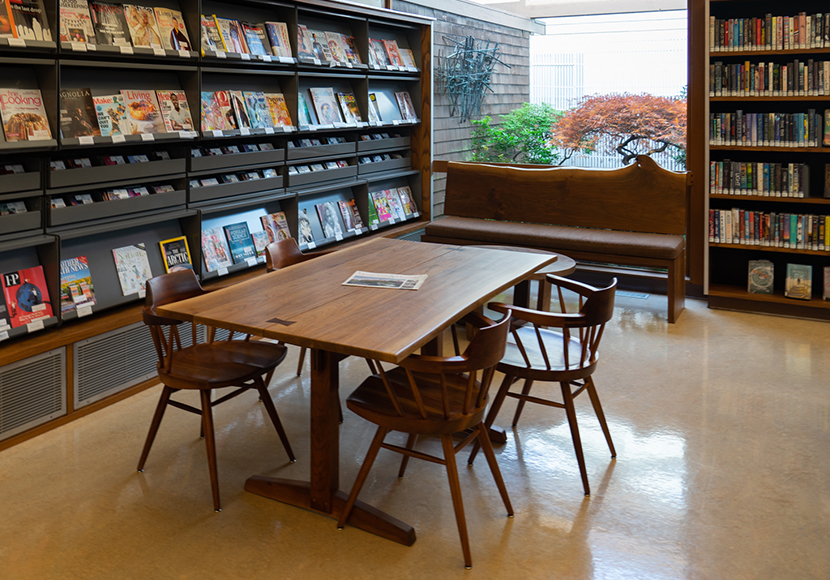
This landmark building is a classic example of Northwest Regional Modernism. The designs of Seattle architects Paul Hayden Kirk and Richard Haag create synergy between the building and the landscape. Renowned artisan George Nakashima created original wood furniture for the library. The furniture is styled to reveal the true form and spirit of nature.
In 2007, Snyder Hartung Kane Strauss Architects renovated the branch. The expansion added more space and a public meeting room. Trees and plants near the addition form a cozy grove. The Library refinished the Nakashima furniture.
Furniture shop Meyer Wells, which at the time was Magnolia-based, created new furniture from reclaimed wood. A walnut tree fell near the branch during 2006 winter storms. The shop made a table and bench from that tree.
Architects: Snyder Hartung Kane Strauss Architects, 2007; Paul Hayden Kirk and Richard Haag, 1964.
Art
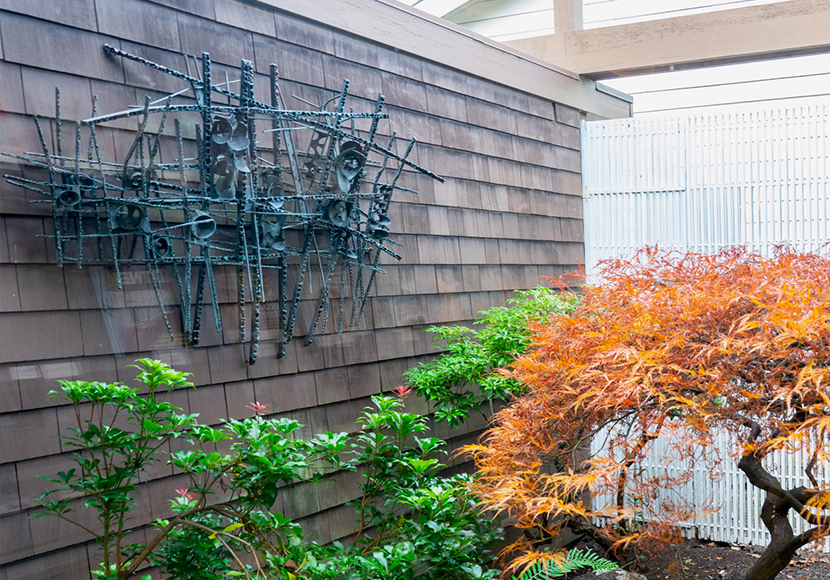
Activity In Thought, 1965
Glen Earl Alps
“Activity in Thought” is a metallic sculpture wall mounted in an exterior courtyard in the northwest corner of the building. It is made of sheet metal and steel rods. The metal is painted with a rich brown colored coating. This piece is part of Alps’ public sculpture work from the 1960s. A pioneer in 20th century printmaking, Alps also established the Printmaking department at the University of Washington. “Activity in Thought” was commissioned by the Magnolia Community Club.
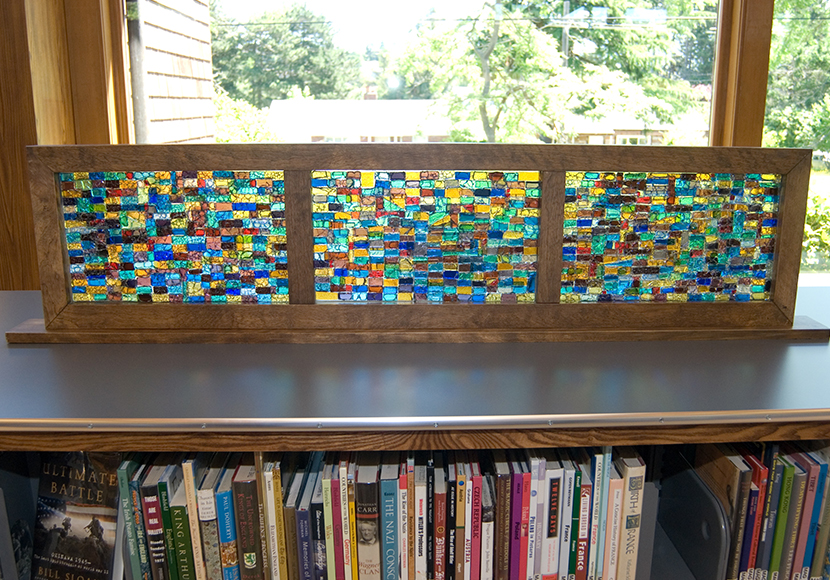
Fused Glass Screen, 1970
Steven D. Fuller
“Fused Glass Screen” displays three panels of fused multicolored glass. The panels are framed in walnut wood and displayed atop a bookcase, underneath a skylight in the center of the building. Fuller, a Seattle artist and UW professor, experimented with fused glass techniques and leatherwork. He taught famed local artist Dale Chihuly in 1961. “Fused Glass Screen” was donated to the Magnolia Branch in memory of Guvnor and Harkin Locker.
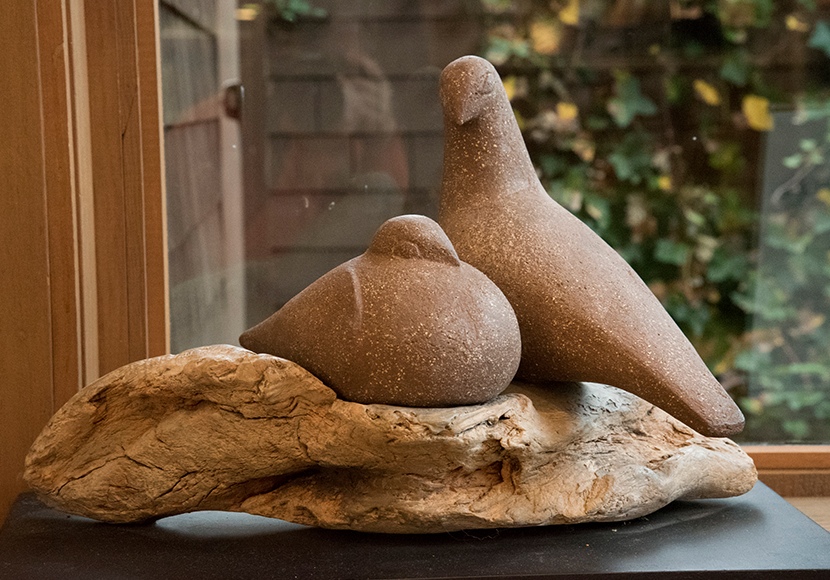
Doves on Driftwood, 1964
Ebba Rapp McLauchlan
“Doves on Driftwood” is displayed near a window in the northeast corner of the building. In this small sculpture, two stone doves nestle on a piece of driftwood. The works of Rapp McLauchlan, a Northwest artist and Cornish professor, have been featured at museums nationwide. She and her husband, photographer John McLauchlan, founded the Northwest Clay Club to promote craft-related art in the Northwest. “Doves on Driftwood” was commissioned by the Magnolia Community Club.
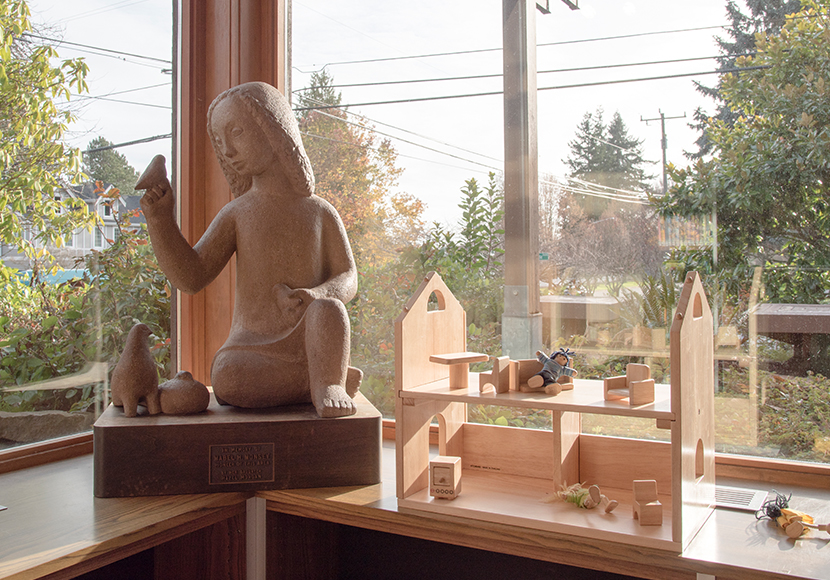
Girl Holding Doves, 1964
Ebba Rapp McLauchlan
“Girl Holding Doves” is a four-foot sculpture in the Children’s section. Three stone doves interact with a kneeling girl. The works of Rapp McLauchlan, a Northwest artist and Cornish professor, have been featured at museums nationwide. She and her husband, photographer John McLauchlan, founded the Northwest Clay Club to promote craft-related art in the Northwest. “Girl Holding Doves” was commissioned by the Magnolia Community Club.
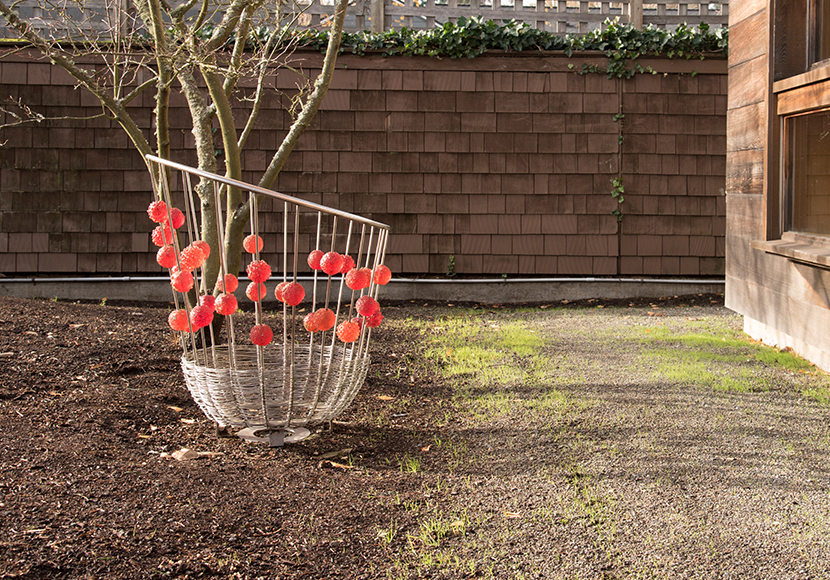
Catch + Release, 2008
Kristin Tollefson
“Catch + Release” is a pair of woven steel wire sculptures featuring beads made from polyurethane resin. They are located inside and outside near a south-facing window on the west side of the building. Tollefson, a Bainbridge Island artist, used a Madrona tree for inspiration. Her art is a metaphor for the library as a fruitful information provider. Patrons "fish" for information. “Catch + Release” was funded by the 1998 Libraries for All bond measure.
Named Spaces
Spaces named for donors include:
- Jim Thixton and Carol Bennett Thixton Meeting Room
- Dean and Mary Thornton Children's Area